
Coping with Divorce: How to Heal, Move Forward, and Reclaim Your Life

Introduction
"Divorce isn't just a legal event—it's an emotional earthquake."
If you're here, chances are you're navigating the heartache, confusion, or even numbness that comes with the end of a marriage. First, take a breath. You’re not alone—and what you’re feeling is valid. Whether the divorce was your choice, theirs, or mutual, the aftermath can leave you feeling emotionally wrecked, mentally scattered, and physically drained.
This guide is here to walk alongside you. We won’t sugarcoat the journey, but we will give you tools to understand your emotions, find stability, and eventually rebuild a life that feels whole again.
You’ll learn:
Why divorce pain cuts so deep
The emotional stages people often go through
Tips to regulate emotions and find daily stability
How to cope when you still love your ex
Gender-specific healing paths
And ultimately, how to move forward
Let’s take it one step at a time.
Understanding the Emotional Impact of Divorce
Why Divorce Hurts So Much
The pain of divorce is unique—and in many ways, it mimics the grief of losing a loved one. But while death often brings closure and support, divorce can feel like an open-ended wound. You’re not just mourning a person—you’re grieving a life you thought you’d have.
The American Psychological Association (APA) notes that divorce can trigger intense psychological stress, often manifesting in depression, anxiety, sleep issues, and even physical health problems like headaches or weakened immunity.
You may feel like your identity is shaken. Your routines, your home, your future plans—suddenly, they all look different. That’s why it hurts so much. It’s not just about love lost; it's about the loss of stability, dreams, and sometimes even self-worth.
Common Emotions People Face
Here’s what many people report feeling after a divorce:
Sadness: A deep sorrow over what was and what will never be.
Anger: At your ex, yourself, or the situation. It can feel like betrayal or injustice.
Fear and Anxiety: What does life look like now? Will you be okay?
Guilt: Could you have done something differently? What about the kids?
Relief: Yes, that too. And then feeling guilty for feeling relieved.
“It was the right decision, but it still broke me.” — Anonymous case study, support group participant
Early Stage Coping: When It’s All Fresh
Coping with Shock and Denial
The first few weeks after a divorce—or even just the initial separation—can feel surreal. You may find yourself thinking:
“Maybe this is just temporary.”
“They’ll come back.”
“This can’t be real.”
These thoughts are natural. Denial and hope for reconciliation are common coping mechanisms in the early stage. You might fluctuate between panic and numbness. That’s okay.
Try “emotional first aid” strategies like:
Breathing exercises: Inhale for 4, hold for 4, exhale for 6.
Journaling: Write without judgment. Let it out.
Connecting with a close friend: Just one. You don’t have to explain everything.
What to Do When Your Spouse Leaves You
If you’ve been left, the pain may feel doubled. The ground may feel like it’s shifting beneath you.
Here's a quick checklist of what to do next:
Secure your space: Change passwords, check finances, safeguard your emotional and physical environment.
Seek legal advice: Even if reconciliation is possible, protect your rights.
Reach out, don’t isolate: Join a divorce support group or talk to a therapist.
Practical Tips for Daily Coping
Building New Routines
One of the best ways to find stability in chaos is to build structure.
Wake up and go to bed at consistent times
Move your body, even just 10 minutes a day
Eat regularly and nourish yourself—yes, even if you’re not hungry
These small anchors will help your brain and body regain a sense of control.
Emotional Regulation Techniques
Journaling: Studies by Mental Health America show it can help process trauma and lower stress levels.
Therapy: According to the Mayo Clinic, counseling improves emotional resilience, especially during life changes.
Support groups: Knowing others feel what you feel can be healing in itself.
E-A-T Tip: We strongly encourage speaking with a Rebuilders coach. While friends and self-help tools are supportive, professional guidance is vital and Rebuilders coaches offer dramatic results in far less time.
What If You Still Love Them?
How to Cope with Divorce When You Still Love Him
Love doesn’t switch off just because a legal document says so. You can grieve a relationship that wasn’t good for you and still miss it deeply. Acceptance doesn’t mean pretending the love wasn’t real—it means acknowledging that love and still choosing to let go.
Try this: Write a letter to your ex. Don’t send it. Just express what you wish you could say. It can be a powerful step toward emotional closure.
Gendered Emotional Journeys
Divorce Advice for Women
Women often face unique challenges post-divorce, such as:
Loss of identity, especially if you were a caregiver or homemaker
Financial instability
Fear of judgment from family, community, or culture
Support and self-reinvention are critical. Start with small wins—budget planning, personal hobbies, reconnecting with friends.
How Men Cope with Divorce
Many men suppress their emotions due to cultural expectations. But unspoken grief still manifests—as anger, isolation, or even workaholism.
Men often delay seeking help. But support groups and therapy can offer tremendous relief.
Stat: A 2021 study published in the Journal of Men's Health found divorced men are 2.5x more likely to experience depression than married men.
Navigating Divorce Grief
Divorce Grief is Real
Just like when someone dies, there are stages: denial, anger, bargaining, depression, acceptance. But unlike death, your ex may still be around—co-parenting, texting, or even moving on publicly. That’s what makes divorce grief feel so messy.
Healthy vs. Unhealthy Coping
Unhealthy patterns:
Isolating yourself for weeks
Numbing with alcohol, drugs, or binge behavior
Lashing out at your ex or children
Healthier alternatives:
Talking to a trusted friend or therapist
Engaging in a new hobby
Volunteering or giving back
How to Begin Healing and Moving On
Accepting the End of the Relationship
Grief often lingers until we give ourselves permission to close the door.
Write a goodbye letter (don’t send it).
List the reasons why the relationship ended.
Say out loud: “I’m allowed to move on.”
These small rituals matter.
Redefining Your Identity After Divorce
You’re no longer someone’s spouse—but you are still you. Rediscover yourself by:
Setting new personal goals
Learning a skill you never had time for
Traveling solo (even locally)
Rebuilding Your Social Life
Loneliness can creep in. Don’t wait for people to check in—take the first step.
Join a meetup group or hobby class
Say yes to invitations
Set boundaries with your ex to protect your peace
Final Thoughts: You Will Get Through This
This chapter may feel like an ending—but it’s also the start of something new. Divorce is hard, but it doesn’t define you. You’re allowed to hurt. You’re allowed to take your time. And you’re absolutely allowed to find joy again.
Lean on support. Choose healing. Trust that this pain will pass.
Further Reading: The Path to Structured Recovery
Trying to simply "push through" the pain or waiting for time to heal you isn't working. You need a proven system. Explore why traditional methods often fall short in an acute crisis and how structured recovery provides the exact path forward:
-
Unlocking Healing After Divorce: Is Therapy or Coaching Right for You?
Why standard weekly therapy might feel too slow for your acute crisis, and how specialized divorce coaching fills the gap. -
How to Find Online Divorce Support Groups with Professional Facilitators
Avoiding toxic online forums and finding structured, expertly guided communities that actually help you heal. -
The Future of Divorce Support: How Online Groups are Changing the Game
Why accessible, online cohorts are the most effective way for busy professionals to get immediate support without disrupting their careers. -
Beyond Divorce Support Groups
Why just talking about your feelings isn't enough, and the importance of combining community with a structured, proven curriculum. -
From Pain to Empowerment: Joining Divorce Recovery Workshops
What happens when you stop trying to handle this alone and join a group of people who truly understand what you are going through. -
Starting Over After Divorce? The 4 Stages of Rebuilding Your Life (RIFT Recovery Pyramid)
A clear, measurable roadmap showing exactly how to move from pure survival mode back to thriving.
Related Posts
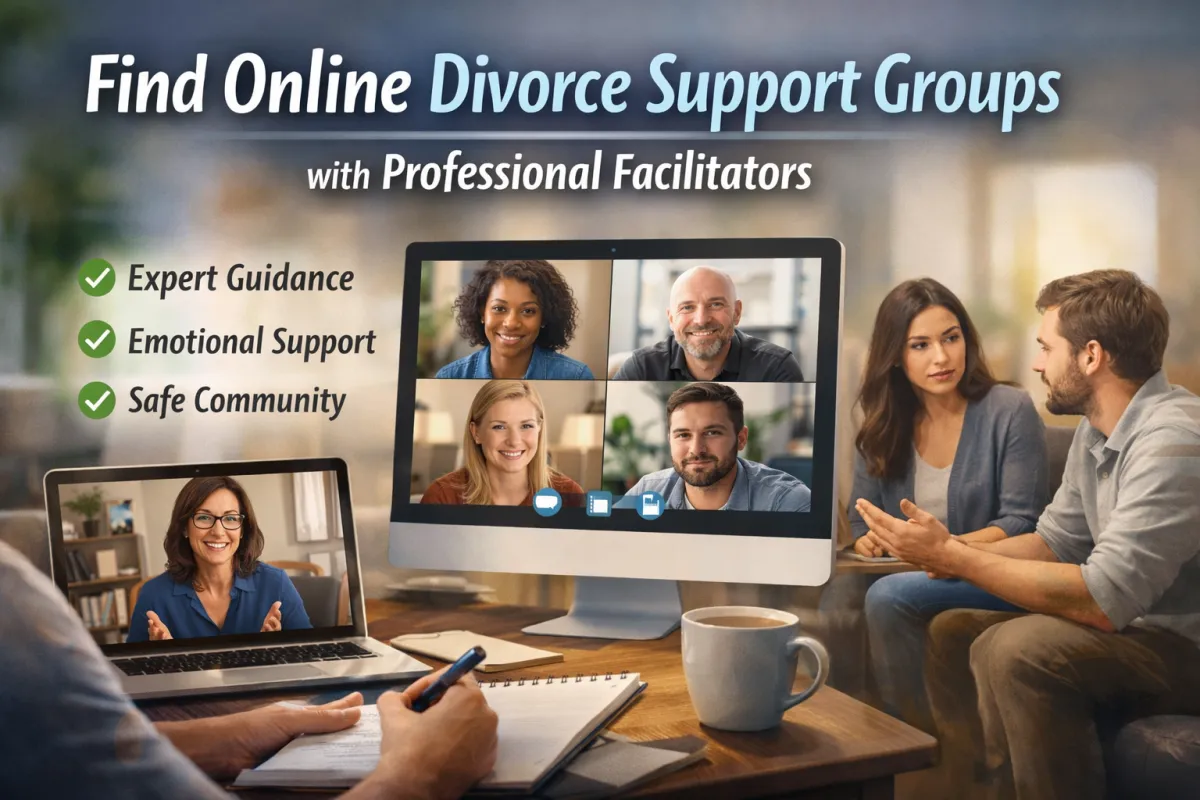
How to Find Online Divorce Support Groups with Professional Facilitators
How to Find Online Divorce Support Groups with Professional Facilitators
A practical, objective guide to choosing the right expert-led virtual support community
If you’re searching for online divorce support groups with professional facilitators you’re likely looking for more than a Facebook group.
You want structure.
You want safety.
You want someone qualified guiding the conversation.
And you want to know you’re not stepping into a chaotic space that leaves you feeling worse.
This guide walks you through how to evaluate reputable online divorce support groups with professional facilitators — and includes an objective comparison of some of the best-known options available.
Why Professional Facilitation Matters in Divorce Support
Divorce is not just a legal event — it’s emotional disorientation.
Common experiences include:
Grief and identity loss
Anger and resentment
Anxiety about finances and parenting
Shame or self-doubt
Fear of being alone
In unmoderated online spaces, those emotions can spiral. Conversations can become:
Repetitive venting
Ex-bashing
Legal advice swapping
Or worse, subtle shaming
A professionally facilitated online divorce support group provides:
Clear boundaries
Emotional containment
Topic guidance
Conflict management
Confidentiality standards
A forward-moving focus
Professional facilitation does not automatically mean therapy — but it does mean leadership is intentional and trained.
The 7 Criteria for Evaluating Online Divorce Support Groups
If you want a structured, reputable online divorce support group, use this checklist.
1. Clear, Identifiable Leadership
Ask:
Who is leading this group?
What is their training or experience?
Do they specialize in divorce recovery?
Is their philosophy clearly explained?
Reputable programs are transparent about leadership.
Red flag: No facilitator information or unclear credentials.
2. Structured Session Format
High-quality online divorce support groups typically include:
A defined weekly topic
Guided discussion
Clear time boundaries
Balanced participation
Possibly breakout rooms for smaller conversations
Structure creates psychological safety.
Unstructured venting sessions can reinforce victim mentality rather than growth.
3. Defined Community Guidelines
Look for:
Confidentiality expectations
Respectful communication rules
Limits on legal advice
No romantic solicitation policies
Clear boundaries around cross-talk
A professional facilitator actively maintains these standards.
4. Emotional Growth Focus (Not Just Problem Rehashing)
Some groups become stuck in:
Replaying betrayal stories
Comparing settlements
Rehearsing resentment
Stronger programs guide members through:
Grief processing
Anger regulation
Identity rebuilding
Boundary development
Trust restoration
The difference is subtle but important:
Are members encouraged to move forward?
5. Evidence of Impact
Look for:
Testimonials
Video feedback
Reviews
Years of operation
Consistent transformation stories are a good sign.
6. Accessibility and Consistency
Ask:
Is the group ongoing or cohort-based?
Does it meet weekly?
Is it easy to join virtually?
Is pricing transparent?
Consistency often matters more than intensity.
7. Clear Scope of Support
A reputable online divorce support group should clearly state:
It is not therapy (unless it is)
It does not provide legal advice
It focuses on emotional support and growth
Clarity builds trust.
Objective Comparison: Popular Online Divorce Support Options
Below is a balanced overview of well-known options people commonly consider when searching for expert-led online divorce support.
1. DivorceCare
Best for: Faith-based, church-centered support.
Overview:
DivorceCare is a widely available 13-week Christian divorce recovery program typically run through churches. Sessions often include video teaching and group discussion.
Strengths:
Structured curriculum
Affordable and widely accessible
Strong Christian foundation
Considerations:
Facilitators are often volunteers with little to no training rather than divorce-recovery specialists
Strongly faith-oriented (ideal for some, not for others)
Usually time-limited rather than ongoing
Best if your primary priority is Christian community and biblical encouragement.
2. Rebuilders Workshop (Fisher-based programs)
Best for: Structured multi-week curriculum with emotional recovery focus.
Overview:
Rebuilders Workshops are often 10-week structured programs centered on emotional healing after relationship loss.
Strengths:
Clear curriculum
Defined progression
Community-based learning environment
Considerations:
Availability varies by region
Often cohort-based (you may wait for start dates)
Facilitation style varies by location
Best if you prefer a defined start and end with a structured educational framework.
3. Therapist-Led Divorce Process Groups
Best for: Clinical-level support.
Overview:
These are typically hosted by licensed therapists and involve formal intake processes.
Strengths:
Clinically trained leadership
Appropriate for trauma, anxiety, or depression within therapeutic scope
Considerations:
Higher cost
More formal setting
Less community-style interaction
Best if you need clinical mental health care alongside divorce recovery.
4. Rebuilders Support Group
Best for: Ongoing, professionally facilitated emotional recovery in a structured community.
Overview:
Rebuilders offers professionally facilitated online divorce support groups designed specifically around emotional recovery and rebuilding after divorce.
How it aligns with the evaluation criteria:
Criteria:
Rebuilders Support Circle
Professional facilitation: ✔ Experienced divorce recovery facilitators
Structured sessions: ✔ Topic-based, guided discussion
Clear boundaries: ✔ Community standards enforced
Emotional growth focus: ✔ Emphasis on rebuilding identity and trust
Ongoing access: ✔ Weekly online meetings
Evidence of impact: ✔ Long track record and participant testimonials
Strengths:
Clear leadership model
Strong emotional growth orientation
Balance between structure and sharing
Ongoing weekly access
Designed specifically for divorce recovery (not generalized group therapy)
Considerations:
Not faith-based
Not therapy (though emotionally structured)
Best if you want consistent, professionally guided emotional recovery in a growth-focused environment.
Quick “Best Fit” Guide
Choose DivorceCare if:
You want Christian-based group support with a fixed curriculum.
Choose Rebuilders Workshop if:
You want a defined multi-week emotional recovery course.
Choose a therapist-led group if:
You need clinical support or mental health treatment.
Choose Rebuilders Support Group if:
You want structured, professionally facilitated, ongoing emotional recovery in a growth-oriented virtual community.
Final Thoughts
When searching for online divorce support groups with professional facilitators, the key is not just finding a group.
It’s finding the right level of structure, guidance, and emotional direction for you.
The best groups:
Contain your emotions without suppressing them
Encourage growth without rushing you
Provide connection without chaos
Offer leadership without control
Divorce is destabilizing.
The right online support group should feel steady.
If you’re evaluating options, ask questions. Observe a session if possible. Compare structure. Notice whether the group moves people forward.
The right professional support doesn’t just help you survive divorce.
It helps you rebuild.