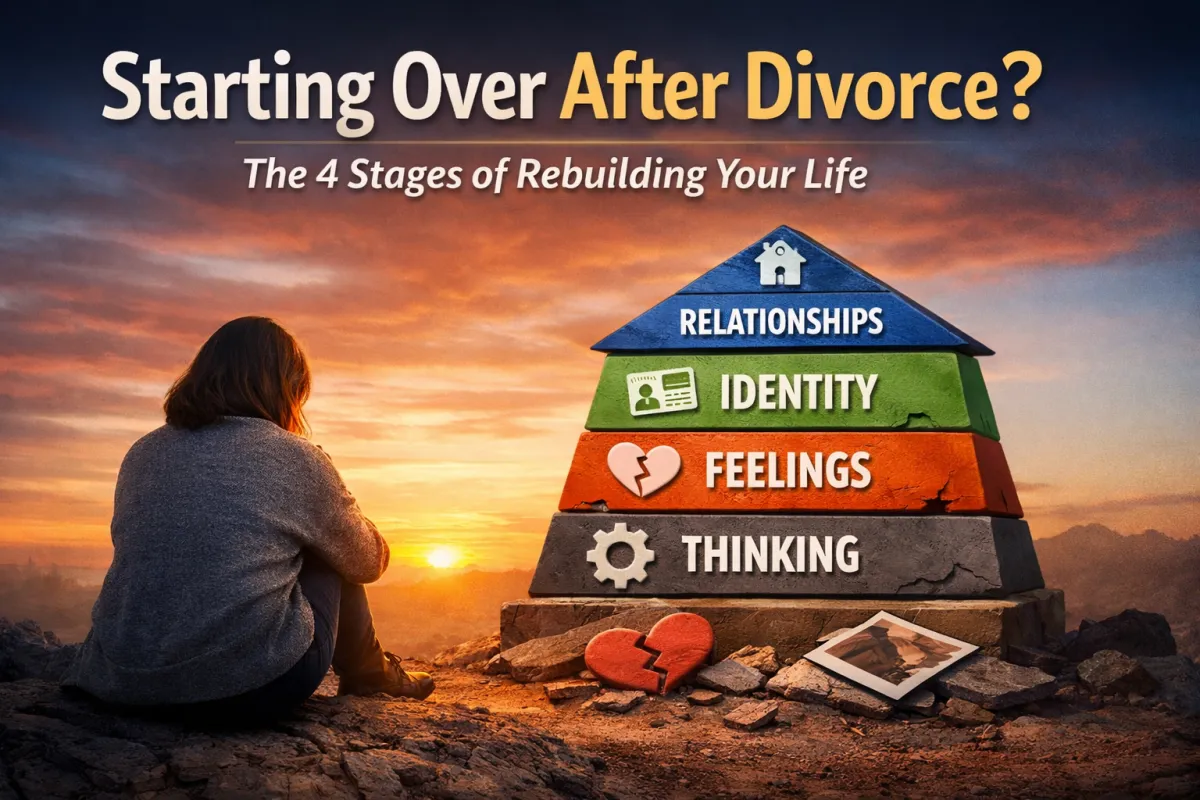
Starting Over After Divorce? The 4 Stages of Rebuilding Your Life (RIFT Recovery Pyramid)
Starting Over After Divorce? The 4 Stages of Rebuilding Your Life (RIFT Recovery Pyramid)
Starting over after divorce can feel like you’re trying so hard… and still sliding backward.
And for many people, it’s not because they’re doing the “wrong” things.
It’s because they’re doing the right work in the wrong order—like trying to put a roof on a house when the foundation is still cracked.
In this post, I’ll walk you through the RIFT Recovery Pyramid, a four-stage blueprint for rebuilding your life after divorce in a way that actually holds up over time:
T = Thinking (foundation)
F = Feelings
I = Identity
R = Relationships (roof)
You’ll also do a quick, simple self-audit so you can identify where you are right now—and what you truly need next.
Table of Contents
The most common trap after divorce
The RIFT Recovery Pyramid (overview)
A quick self-audit (1–10)
How the Self Test scores work (two formats)
The #1 rule + the 3 score ranges
Stage 1: Thinking (Disentanglement / mental spirals)
Stage 2: Feelings (Grief + Anger)
Stage 3: Identity (Self-Worth + Social Self-Worth)
Stage 4: Relationships (Social Trust)
How to use your scores today
FAQs
1) The Trap: Fixing the Loudest Pain First
When a relationship ends, the pain isn’t just emotional—it’s total.
It can hit:
your thinking and focus
your sleep
your confidence
your identity
your social life
And the most common mistake people make is trying to fix whatever hurts the loudest first.
You feel lonely → so you try to date
You feel anxious → so you force “closure”
You feel worthless → so you chase reassurance
You feel overwhelmed → so you try to “figure it all out”
But healing has a kind of physics to it.
You can’t build the second floor if the foundation is unstable.
2) The RIFT Recovery Pyramid: A Blueprint for Divorce Recovery
Here’s the structure:
T = Thinking (Foundation)
This is where your brain gets back online—less obsession, less looping, more stability.
F = Feelings
This is where you learn to process grief and anger without getting knocked off your feet.
I = Identity
This is where self-worth and confidence come back—and you rebuild the “you” that got shaken.
R = Relationships (Roof)
This is where trust returns—trust in others and trust in your own judgment again.
Important: Relationships are the roof. Thinking is the foundation.
If you try to build a new relationship before your foundation is solid, the whole structure tends to collapse.
3) Quick Mini-Audit: Rate Your 4 Layers (1–10)
Don’t overthink this. Just be honest.
Rate each area from 1 to 10:
1 = deeply affected
10 = the best you could realistically be right now
Thinking
How clear is your thinking today? How “online” does your brain feel?
Feelings
How intense are the emotional waves (grief or anger)? How quickly do you recover?
Identity
Do you still feel like you? How’s your self-worth and confidence?
Relationships
Do people feel safe? Can you trust others—and your own judgment—again?
Write down your four numbers.
That gives you a rough snapshot.
If you want precise measurement and a way to track progress, that’s where the Self Test comes in.
4) The Self Test: Two Score Formats (Both Map to the Same Recovery Path)
Our Self Test is based on the work of Dr. Bruce Fisher and designed to measure how you’re adjusting—so you can stop guessing.
Depending on the version you took, you’ll see your scores in one of two formats:
Format A: 100-Question Fisher Divorce Adjustment Scale
You’ll see:
Disentanglement
Grief
Anger
Self-Worth
Social Self-Worth
Social Trust
Overall Score
Format B: 25-Question Divorce Recovery Score (RIFT)
You’ll see:
Thinking
Feelings
Identity
Relationships
Overall Score
Either way, the purpose is the same:
a clear picture of where you’re steady, where you’re struggling, and what to focus on next.
5) The #1 Rule + The Only 3 Score Ranges You Need
The #1 rule:
Higher scores = more adjusted. Lower scores = less adjusted.
A low score isn’t a verdict. It’s a signal.
It means: “This layer needs support and structure.”
The 3 ranges:
80 and above: Target range (stable and grounded)
40 to 79: In progress (functioning, but still getting hit)
39 and below: Struggling (this area is actively disrupting life—sleep, focus, mood, decisions, confidence)
Here’s the key most people miss:
We don’t start by chasing the lowest category.
We start at the bottom of the pyramid.
Because if Thinking is unstable, everything above it becomes harder.
6) Stage 1: Thinking (Disentanglement / Stopping the Spiral)
Stage 1 is Thinking.
In the assessment, this is measured primarily through Disentanglement—how much space your ex and the relationship are taking up in your head.
When this score is low, it often looks like:
obsessive thoughts / mental loops
replaying conversations at 3 a.m.
checking their social media even though it hurts
bargaining (“If I explain it right…”)
feeling like you need closure to move forward
Here’s the hard truth:
You can’t process feelings if your brain is hijacked.
This is why people say, “I’m doing all the right things, but I still feel stuck.”
They’re trying to use logic to solve what is, at its core, a nervous-system loop.
What to do in Stage 1
1) Reduce exposure
Create strict boundaries with social media and communication.
You’re not being cold—you’re protecting your mental environment so you can heal.
2) Stabilize the basics
Sleep. Food. Movement. Simple structure.
When the brain is exhausted, everything gets harder.
3) Find your power (on purpose)
Many people feel helpless, hopeless, or lost.
Often, that’s mental overwhelm—and it’s exactly what low disentanglement represents.
A simple intention (one that inspires you and gives you strength) can have surprising benefits.
If your Thinking layer is under 40:
Don’t worry about dating. Don’t worry about your five-year plan.
Focus on getting your brain back online first.
7) Stage 2: Feelings (Grief + Anger)
Once your mind is stable enough to focus, you move up to Feelings.
This is where we deal with Grief and Anger.
And notice—we didn’t start here.
Because if you dive into deep grief while your mind is still obsessing, it can feel like drowning.
But once Thinking is steadier, you can build a container for emotion.
Grief after divorce
Grief isn’t weakness. It’s attachment.
It’s love with nowhere to go.
Divorce is also a loss of expectations—hopes, dreams, the future you pictured.
Low grief scores often show up as:
waves that hit out of nowhere
mornings, nights, or weekends feeling unbearable
crying… or numbness
What helps:
recognizing grief for what it is (not a problem to “solve”)
learning to feel it instead of avoiding it
understanding this truth: if you take the time it takes, it takes less time
Anger after divorce
A lower anger score doesn’t automatically mean you’re “rageful.”
Often it means you feel powerless.
A better frame:
Anger is your dignity’s bodyguard.
It’s the part of you saying, “I deserved better than this.”
What helps:
don’t suppress anger, but don’t let it drive the car
use anger as fuel for boundaries, clarity, and self-respect—without turning it into conflict
because if anger pulls you into fights, texts, court drama, or obsession… it often drops you back into Stage 1
8) Stage 3: Identity (Self-Worth + Social Self-Worth)
Stage 3 is Identity.
Divorce is an identity injury.
You didn’t just lose a partner.
You lost the version of yourself who was a husband or wife.
You lost the future you thought you had.
When Identity scores are low, people often feel:
shame (“How did I let this happen?”)
rejection (“I wasn’t chosen.”)
fear (“I’m too old / unlovable / I can’t start over.”)
social collapse (“I don’t even know where I fit anymore.”)
But this is also the Life 2.0 phase—not in a cheesy way. In a real way.
You’re rebuilding who you are—and you can rebuild it stronger.
What to do in Stage 3
Rebuild self-trust through evidence.
Self-trust is built by small promises kept:
“I’m going to the gym.” And you go.
“I’m going to stop checking their socials.” And you stop.
“I’m going to save money.” And you do.
Every promise kept becomes proof.
And proof stabilizes identity.
This is where you move from “we” back to “me.”
9) Stage 4: Relationships (Social Trust)
At the top is Relationships, measured primarily through Social Trust.
This is where people often mess up:
They try to put the roof on before the foundation is dry.
If you try to date when:
your thinking is obsessive
your feelings are volatile
your identity is crushed
…you tend to attract chaos, accept what you shouldn’t, or get hurt again.
But if you’ve climbed the pyramid—stable mind, processed feelings, stronger identity—
relationships become a choice, not a life raft.
What to do in Stage 4
start with safe connections (friendships and community first—not necessarily romance)
learn to trust slowly
learn to trust your judgment again
10) How to Use Your Scores Today
If you’ve taken the assessment, here’s the simplest way to use your numbers:
Look at your overall score
Start at the bottom: Thinking
Then move up: Feelings → Identity → Relationships
And remember:
If Thinking is low—especially under 40—stop worrying about your relationship score.
Fix the foundation first.
If you haven’t taken the Self Test yet, you can start here:
If you want the workbook we use in our programs: https://amzn.to/3zgxuVF
Disclosure: This is an Amazon affiliate link, which means we may earn a small commission at no additional cost to you.
FAQs
What are the stages of divorce recovery?
A practical way to understand divorce recovery is the RIFT Recovery Pyramid: Thinking → Feelings → Identity → Relationships. The order matters because stability at the bottom supports everything above it.
Why do I feel stuck even though I’m trying so hard?
Often it’s because you’re doing “higher-level” work (dating, rebuilding identity, forcing closure) before your Thinking layer is stable. If your mind is still hijacked by mental loops, everything else becomes harder.
Should I date after divorce if I feel lonely?
Loneliness is real—but dating too early can backfire if your Thinking, Feelings, or Identity layers are unstable. A safer first step is building supportive friendships and community while you stabilize the foundation.
What score range is “good” on a divorce recovery assessment?
Use these simple ranges:
80+ stable/target
40–79 in progress
39 and below struggling (actively disrupting life)
A simple check-in question
Looking at the four layers—Thinking, Feelings, Identity, Relationships—which one feels heaviest for you right now?