
Coping with Divorce: How to Heal, Move Forward, and Reclaim Your Life

Introduction
"Divorce isn't just a legal event—it's an emotional earthquake."
If you're here, chances are you're navigating the heartache, confusion, or even numbness that comes with the end of a marriage. First, take a breath. You’re not alone—and what you’re feeling is valid. Whether the divorce was your choice, theirs, or mutual, the aftermath can leave you feeling emotionally wrecked, mentally scattered, and physically drained.
This guide is here to walk alongside you. We won’t sugarcoat the journey, but we will give you tools to understand your emotions, find stability, and eventually rebuild a life that feels whole again.
You’ll learn:
Why divorce pain cuts so deep
The emotional stages people often go through
Tips to regulate emotions and find daily stability
How to cope when you still love your ex
Gender-specific healing paths
And ultimately, how to move forward
Let’s take it one step at a time.
Understanding the Emotional Impact of Divorce
Why Divorce Hurts So Much
The pain of divorce is unique—and in many ways, it mimics the grief of losing a loved one. But while death often brings closure and support, divorce can feel like an open-ended wound. You’re not just mourning a person—you’re grieving a life you thought you’d have.
The American Psychological Association (APA) notes that divorce can trigger intense psychological stress, often manifesting in depression, anxiety, sleep issues, and even physical health problems like headaches or weakened immunity.
You may feel like your identity is shaken. Your routines, your home, your future plans—suddenly, they all look different. That’s why it hurts so much. It’s not just about love lost; it's about the loss of stability, dreams, and sometimes even self-worth.
Common Emotions People Face
Here’s what many people report feeling after a divorce:
Sadness: A deep sorrow over what was and what will never be.
Anger: At your ex, yourself, or the situation. It can feel like betrayal or injustice.
Fear and Anxiety: What does life look like now? Will you be okay?
Guilt: Could you have done something differently? What about the kids?
Relief: Yes, that too. And then feeling guilty for feeling relieved.
“It was the right decision, but it still broke me.” — Anonymous case study, support group participant
Early Stage Coping: When It’s All Fresh
Coping with Shock and Denial
The first few weeks after a divorce—or even just the initial separation—can feel surreal. You may find yourself thinking:
“Maybe this is just temporary.”
“They’ll come back.”
“This can’t be real.”
These thoughts are natural. Denial and hope for reconciliation are common coping mechanisms in the early stage. You might fluctuate between panic and numbness. That’s okay.
Try “emotional first aid” strategies like:
Breathing exercises: Inhale for 4, hold for 4, exhale for 6.
Journaling: Write without judgment. Let it out.
Connecting with a close friend: Just one. You don’t have to explain everything.
What to Do When Your Spouse Leaves You
If you’ve been left, the pain may feel doubled. The ground may feel like it’s shifting beneath you.
Here's a quick checklist of what to do next:
Secure your space: Change passwords, check finances, safeguard your emotional and physical environment.
Seek legal advice: Even if reconciliation is possible, protect your rights.
Reach out, don’t isolate: Join a divorce support group or talk to a therapist.
Practical Tips for Daily Coping
Building New Routines
One of the best ways to find stability in chaos is to build structure.
Wake up and go to bed at consistent times
Move your body, even just 10 minutes a day
Eat regularly and nourish yourself—yes, even if you’re not hungry
These small anchors will help your brain and body regain a sense of control.
Emotional Regulation Techniques
Journaling: Studies by Mental Health America show it can help process trauma and lower stress levels.
Therapy: According to the Mayo Clinic, counseling improves emotional resilience, especially during life changes.
Support groups: Knowing others feel what you feel can be healing in itself.
E-A-T Tip: We strongly encourage speaking with a Rebuilders coach. While friends and self-help tools are supportive, professional guidance is vital and Rebuilders coaches offer dramatic results in far less time.
What If You Still Love Them?
How to Cope with Divorce When You Still Love Him
Love doesn’t switch off just because a legal document says so. You can grieve a relationship that wasn’t good for you and still miss it deeply. Acceptance doesn’t mean pretending the love wasn’t real—it means acknowledging that love and still choosing to let go.
Try this: Write a letter to your ex. Don’t send it. Just express what you wish you could say. It can be a powerful step toward emotional closure.
Gendered Emotional Journeys
Divorce Advice for Women
Women often face unique challenges post-divorce, such as:
Loss of identity, especially if you were a caregiver or homemaker
Financial instability
Fear of judgment from family, community, or culture
Support and self-reinvention are critical. Start with small wins—budget planning, personal hobbies, reconnecting with friends.
How Men Cope with Divorce
Many men suppress their emotions due to cultural expectations. But unspoken grief still manifests—as anger, isolation, or even workaholism.
Men often delay seeking help. But support groups and therapy can offer tremendous relief.
Stat: A 2021 study published in the Journal of Men's Health found divorced men are 2.5x more likely to experience depression than married men.
Navigating Divorce Grief
Divorce Grief is Real
Just like when someone dies, there are stages: denial, anger, bargaining, depression, acceptance. But unlike death, your ex may still be around—co-parenting, texting, or even moving on publicly. That’s what makes divorce grief feel so messy.
Healthy vs. Unhealthy Coping
Unhealthy patterns:
Isolating yourself for weeks
Numbing with alcohol, drugs, or binge behavior
Lashing out at your ex or children
Healthier alternatives:
Talking to a trusted friend or therapist
Engaging in a new hobby
Volunteering or giving back
How to Begin Healing and Moving On
Accepting the End of the Relationship
Grief often lingers until we give ourselves permission to close the door.
Write a goodbye letter (don’t send it).
List the reasons why the relationship ended.
Say out loud: “I’m allowed to move on.”
These small rituals matter.
Redefining Your Identity After Divorce
You’re no longer someone’s spouse—but you are still you. Rediscover yourself by:
Setting new personal goals
Learning a skill you never had time for
Traveling solo (even locally)
Rebuilding Your Social Life
Loneliness can creep in. Don’t wait for people to check in—take the first step.
Join a meetup group or hobby class
Say yes to invitations
Set boundaries with your ex to protect your peace
Final Thoughts: You Will Get Through This
This chapter may feel like an ending—but it’s also the start of something new. Divorce is hard, but it doesn’t define you. You’re allowed to hurt. You’re allowed to take your time. And you’re absolutely allowed to find joy again.
Lean on support. Choose healing. Trust that this pain will pass.
Related Posts
Life After Divorce
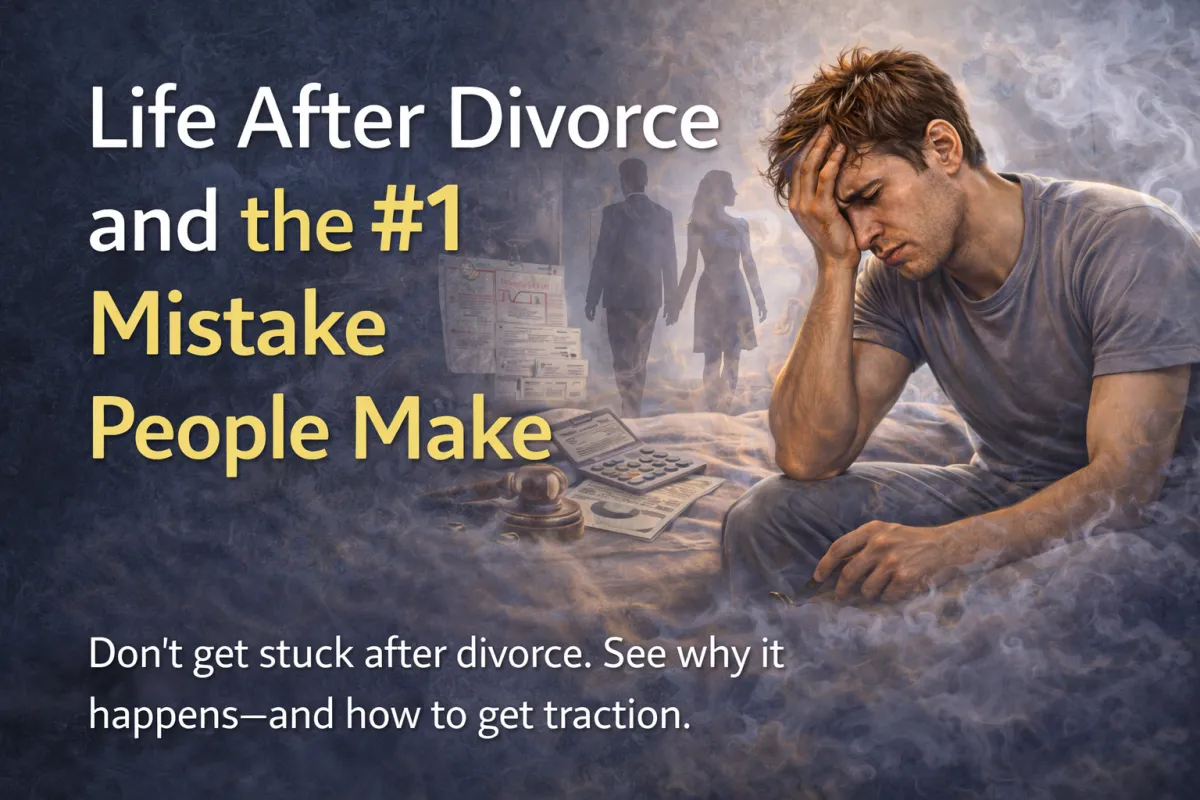
Life After Divorce: The #1 Mistake People Make (and How to Stop Feeling Stuck)
Life after divorce can feel like you’re trying to rebuild your life while walking through fog.
Some relationships die slowly. But in my experience, more often they disintegrate quickly—one rupture, one line crossed, one moment that changes everything. And once that rupture happens, there’s no going back to the way it was.
For most people, the hardest part isn’t the day the relationship ends.
It’s what happens in the weeks and months after—when you’re trying to function, parent, work, sleep, and rebuild a life that doesn’t look like what you thought it would.
If that’s you, this post is here to do three things:
Name what’s happening (so you stop feeling crazy)
Explain why you’re stuck (so the confusion drops)
Give you an obvious next step (so you can get traction)
The real reason life after divorce feels so hard
Most people struggle to recover after divorce, not because they’re not trying.
They struggle because they don’t have a map.
They’re dealing with intense emotions, huge decisions, and constant uncertainty—at the same time—and their nervous system gets locked into a loop.
Once you see the loop, you’ll recognize it immediately.
The typical pattern: how the spiral starts
At some point in a relationship, the possibility of divorce becomes real to both people.
Usually one person initiates the divorce and the other resists the ending of the marriage.
If you’re the one who didn’t want it, you’re often in some version of shock. You didn’t expect this—and now you’re overwhelmed on multiple levels.
Here’s what tends to happen next:
There’s a rupture in the relationship
Your self-worth drops
Big emotions show up (anger, grief, shame, fear… and more)
Your mind fills with questions you can’t answer
And people cycle among all of these.
We use an acronym for the four major areas that get hit:
RIFT → Relationships, Identity, Feelings, Thoughts
It often looks like:
awkwardness in the same space
tension and less warmth
hard conversations that go nowhere
feeling alone inside the relationship
The Divorce Doom Loop (the nervous system trap)
This loop is a huge reason why life after divorce can feel confusing and heavy.
I call it:
THE DIVORCE DOOM LOOP
Here’s the loop in one sentence:
Overwhelm turns into numbness. Numbness turns into rumination. Rumination turns into panic. Panic turns into reactive decisions… and that throws you right back into overwhelm.
Let’s break it down.
1) Overwhelm
Too many decisions. Too much fear. Too many unknowns.
2) Numbness
Your system protects you. You go flat. You go robotic. You do what you have to do.
3) Rumination
Then your brain tries to “solve” it. Replay. Rehearse. What if. Why. How could they.
4) Panic
And when you can’t get certainty, your body experiences it like danger.
5) Reactivity
This is when people:
send the long text
agree to something they regret
pick a fight or avoid everything
spend money impulsively
escalate legally
If you’re in this loop, it doesn’t mean you’re weak.
It means you’re human—and you’re in a nervous-system loop.
Why this loop quietly makes divorce more expensive
Divorce has three pillars:
Legal
Financial
Emotional
And if you have kids, there’s a fourth pillar that becomes very real, very fast:
Parenting
Here’s the mistake almost everyone makes (and it’s completely understandable):
Most people put their time and money into the legal and financial pillars.
Lawyers. Paperwork. Deadlines. The house. Support. Custody schedules.
And yes—those things matter.
But divorce is also an emotional injury. And if you don’t work directly with the emotional pillar, it quietly drives what happens in the other pillars.
The dashboard model
Imagine a dashboard with four knobs—one for each pillar:
Emotional (the biggest knob—the “master”)
Legal
Financial
Parenting (if kids)
Above them are resource meters that show how much of your resources are being used:
Time
Money
Attention
Energy
Here’s what most people don’t realize:
When the Emotional knob gets turned up to a 10—overwhelm, panic, shame, grief—the resource meters don’t stay contained to “emotions.”
They amplify everything.
Legal costs go up (more conflict, more back-and-forth, more attorney time)
Financial fallout increases (more mistakes, more impulsive decisions, more delays)
Energy loss skyrockets (sleep problems, focus problems, decision fatigue)
Parenting stress intensifies (communication breakdowns, co-parenting conflict)
Even if you don’t know attorney hourly rates, you already understand the principle:
Conflict creates more steps.
More steps take more time.
More time costs money.
How to “measure” when your emotional dial is too high
This matters because the emotional dial isn’t theoretical. You can see it in real life behaviors.
When the emotional dial is high, people tend to do predictable things:
send long emotional messages (to their ex or their attorney)
respond quickly instead of strategically
change their mind repeatedly
avoid paperwork or miss deadlines because they’re overwhelmed
negotiate for validation instead of outcomes
lose sleep and can’t focus, because stress eats the whole day
Those behaviors aren’t “you being crazy.”
That’s the Doom Loop driving your actions.
And those actions create real-world outcomes:
more legal time
more financial fallout
more energy loss
The hidden costs no one warns you about
There’s another cost people don’t calculate—because it doesn’t show up on an invoice.
If the emotional pillar stays unaddressed, life after divorce can start taking things from you.
Work and career
People lose focus, make mistakes, miss deadlines, derail their career—sometimes even lose their job.
Relationships
Friendships fade. Family relationships strain. Not because you don’t care—because you’re overwhelmed, isolated, irritable, or ashamed, and you don’t have the bandwidth.
Health
Sleep gets wrecked. Anxiety spikes. Blood pressure can rise. Coping behaviors increase.
And for some people, it gets very dark—hopelessness, suicidal thoughts.
If you’re there, you don’t have to carry that alone. Please reach out to someone right now—a trusted person, a professional, or emergency services if you’re in immediate danger. You matter more than this moment.
“Won’t the emotions just go away once it’s final?”
A lot of people think:
“Once the divorce is final, the emotions will go away.”
But grief and anger don’t disappear because paperwork got signed.
They fade when they’re processed and integrated.
If they’re not processed, they keep spiking the emotional dial—sometimes weeks later, sometimes months later—right when you thought you “should be over it.”
That’s why so many people feel stuck in life after divorce.
They’re doing the legal work. They’re trying to handle the finances. They might even be trying to date.
But internally, the emotional dial is still pegged—so everything keeps feeling chaotic.
Here’s the good news: you don’t need to fix everything today
What you need first is clarity.
Because right now your brain is trying to create certainty by replaying everything—and that keeps you stuck in the Doom Loop.
So instead of guessing…
Measure.
The next step: take the free self-test
The obvious next step is to take our free self-test.
It gives you something most people don’t have in life after divorce: a clear snapshot of where you actually are.
Here’s what it does:
It shows you how “turned up” your emotional dial is right now—how flooded your system is
It breaks that down across the four RIFT areas: Relationships, Identity, Feelings, Thoughts
It gives you a score you can retake anytime, so you can measure progress (not just hope you’re improving)
So you’re not getting generic advice.
You’re getting a map.
You’ll be able to see something like:
“My Thinking is spinning.”
“My Feelings are overwhelming.”
“My Identity took a hit.”
“Relationships are where I’m struggling most.”
And when you can see it clearly, you stop trying random fixes.
You take the right next step, in the right order.
What life after divorce looks like when you get traction
Traction doesn’t mean everything is perfect.
It means you’re not stuck in the loop.
Your emotional dial comes down. Your decisions get cleaner. Communication gets calmer. You stop reacting and start responding.
And when that happens, the other resource meters stop being amplified.
That’s why I’ll say this plainly:
I’m not saying legal and financial don’t matter. They do.
I’m saying the emotional pillar is the steering wheel.
When the emotional dial is at a 10, your resources drain across the board—time, money, attention, energy.
When you turn it down, everything becomes easier to manage.
So if life after divorce has felt confusing, heavy, or like you’re stuck in a loop—start here:
FAQ: Life After Divorce
How long does it take to feel normal after divorce?
There’s no universal timeline. Many people feel “functional” before they feel truly stable. The most important thing is having a plan and measuring progress—especially around Thoughts (rumination), Feelings (flooding), Identity (self-worth), and Relationships (boundaries and support).
Why can’t I stop thinking about my ex?
Rumination is your brain trying to solve uncertainty and regain control. Without a map, your mind replays the story endlessly. The solution isn’t “try harder to stop thinking.” It’s to reduce uncertainty, regulate the nervous system loop, and focus on the right recovery stage first.
Does focusing on emotions really help with legal and financial outcomes?
Emotions don’t replace legal strategy or financial planning—but they strongly influence behavior. When people are emotionally flooded, they tend to react, escalate conflict, and create more steps in the process—steps that cost time, money, and energy.
What should I do first after divorce?
Get clarity on where you are. Before you try to “move on,” measure your recovery across Relationships, Identity, Feelings, and Thoughts. Then focus on the weakest area first, not the one you wish was easier.