
How to Cope with Divorce When You Still Love Him: Healing Without Closure

Introduction
Still loving your ex-husband doesn’t make you foolish. It makes you human.
Maybe you didn’t want the divorce. Maybe you were blindsided. Or maybe you agreed to it but didn’t expect the grief to hit this hard. Whatever your story, if you’re here thinking, “I still love my ex-husband… So how do I move on?” — know this:
You are not alone.
Your feelings are valid.
And healing is still possible—even when love lingers.
In this guide, we’ll explore:
Why you still love him
How to sit with emotional pain without being consumed by it
What not to do when you feel stuck in love
Gentle steps to emotionally detach and reclaim yourself
Where to find support that truly understands
You don’t need to erase your love to begin healing. Let’s honor it—without letting it hold you back.
Why You Might Still Love Him
You Didn’t Want the Divorce
Sometimes the pain isn’t just about loss—it’s about powerlessness. If you didn’t choose the divorce, it can feel like your heart was dragged behind someone else’s decision.
You’re mourning not just what was, but what could have been—a future you were still invested in.
Long-Term Emotional Bonds Don’t Break Overnight
Even if the relationship was painful or unbalanced, emotional bonds—especially after years together—run deep. You may be experiencing:
Nostalgia for the good moments
Trauma bonding if the relationship involved emotional highs and lows
Genuine enduring love, where you still see the good in him
Let go of the idea that “I should be over this by now.” You don’t heal on anyone’s timeline.
Love Is Not a Switch — It’s a Process
Feelings don’t follow logic. You can know someone isn’t right for you and still love them. You can recognize the toxicity and still miss the touch.
“You can love someone and still decide they are not right for your life.” – Unknown
Letting go isn’t about denying love. It’s about choosing peace over attachment.
How to Sit With the Pain Without Letting It Consume You
What You’re Feeling Is Real — and Valid
It’s tempting to minimize your feelings or shame yourself for still being in love. But pushing those emotions down won’t help. In fact, it can prolong your pain.
Grief over a divorce—especially one from someone you still love—is complex. It includes:
Emotional longing
Identity confusion
Even physical symptoms like exhaustion, nausea, and insomnia
According to the APA, emotional recovery from divorce typically takes 1–2 years, depending on the depth of the relationship.
Create Space to Grieve the Relationship Fully
You’re not just grieving a person—you’re grieving:
Future holidays you imagined
Growing old together
The inside jokes, routines, shared history
This kind of loss deserves full grief. It’s okay to:
Cry daily
Talk to the version of him that lives in your head
Miss him and still not want him back
Journaling, Crying, Meditating — Tools to Express Without Judgment
Try the "Unsent Letter" exercise:
Write a letter to your ex as if you could say anything.
Say what hurt. Say what you miss. Say goodbye.
Then burn it, shred it, or save it—but don’t send it.
Also consider:
Guided meditations for heartbreak
Crying in the shower (it’s a safe, private space)
Daily journaling prompts like:
“Today, I wish I could tell him…”
“Loving him taught me…”
What NOT to Do When You Still Love Him
Don’t Beg, Chase, or Reopen the Wound
Every time you text, check his social, or ask “Can we talk?”, you're reopening a scab that’s trying to heal.
Emotional relapses are normal—but giving in to them can prolong the grief.
Set limits:
Block or mute him temporarily if needed
Ask a friend to help you stay accountable
Remember that no new conversation will erase the old pain
Don’t Suppress or Numb the Feelings
Pushing feelings down often leads to:
Anxiety
Depression
Unexplained physical symptoms
Don’t feel weak for crying. Don’t feel crazy for missing him. Don’t drown your pain in alcohol, rebound flings, or overworking.
What’s not expressed will eventually demand your attention.
Don’t Let Hope Override Reality
Redefining “You” After Divorce
Hope can be comforting—but also dangerous. Holding onto false hope can keep you stuck in a fantasy.
Instead, try Radical Acceptance — a concept from Dialectical Behavior Therapy (DBT):
“This is happening. I don’t have to like it. But I accept that I cannot change it.”
Acceptance isn’t defeat. It’s the first breath of freedom.
Steps to Emotionally Detach and Reclaim Yourself
Emotional Boundaries – Redefine the Relationship (Even If Co-Parenting)
If you still have contact (e.g., co-parenting), shift how you engage:
Keep conversations transactional, not emotional
Don’t seek validation or flirtation
Avoid sharing your feelings unless it’s part of closure
You’re redefining the emotional contract. He is no longer your comfort zone.
“Love Doesn’t Mean You Have to Stay” – Reframing the Narrative
It’s possible to:
Love him and leave him
Miss him and not go back
Remember the good and still choose yourself
“Healing after divorce from someone you love is like carrying two truths: I still love him. I know I must move on.”
Pour That Love Back Into Yourself
All that love you have for him? Redirect it:
Nurture your body with good food, rest, and gentle movement
Take up a creative outlet (art, music, writing)
Practice self-talk that’s kind:
“I am worthy, even when I feel broken.”
“My love is not wasted—it was real, and so is my healing.”
Who Can Help You Heal
Talking to a Therapist or Divorce Coach
Therapy isn’t just for the broken—it’s for the becoming.
A therapist gives you:
A container for your emotions
Tools to manage grief
A mirror for your worth when you forget it
Recommended expert: Kevin Van Liere
Joining a Support Group of Others Who Understand
Sometimes the most healing words are:
“I’ve been there too.”
Find community through:
Facebook groups for women post-divorce
Local or virtual support groups
Podcasts like The Love, Happiness & Success Podcast
These spaces remind you: you’re not alone.
Final Words: Love Doesn’t Disqualify You From Healing
You are allowed to:
Miss him
Cry about him
Still feel love for him
AND
Set boundaries
Choose healing
Build a new life
Love doesn’t mean you wait. Love doesn’t mean you chase.
Love means honoring what was—and trusting that what’s next can still be beautiful.
You can give yourself closure. You can give yourself peace.
Further Reading: Breaking the Rumination Cycle
You cannot simply "willpower" your way out of intrusive thoughts. Breaking the psychological loop of an unwanted divorce requires understanding why your brain is stuck. Use these resources to start dismantling the obsession:
-
Nick's Rumination Masterclass: Overcoming Regret and Moving Forward
A deep dive into the specific tools needed to interrupt the cycle of regret and stop punishing yourself for the past. -
Unanswerable Questions: Healing Post-Divorce
How to accept that you may never get the "closure" or explanation you are desperately searching for from your former spouse. -
Why Do We Hold onto Our Exes?
Understanding the psychological mechanics of trauma bonds and why letting go feels impossible when you were the one left behind. -
When Your Ex Moves On: Why It Hurts So Much (And How to Finally Let Go)
Navigating the unique, acute pain of watching your former spouse live a new life while you are still grieving the old one. -
Letting Go Made Easy: Navigate the Top 5 Obstacles
Identifying the hidden emotional roadblocks that are keeping your brain actively stuck in the past. -
Is Pointing the Finger Keeping You Stuck?
Transitioning out of the victim mindset, releasing the anger of being blindsided, and taking back control of your mental bandwidth.
Related Posts
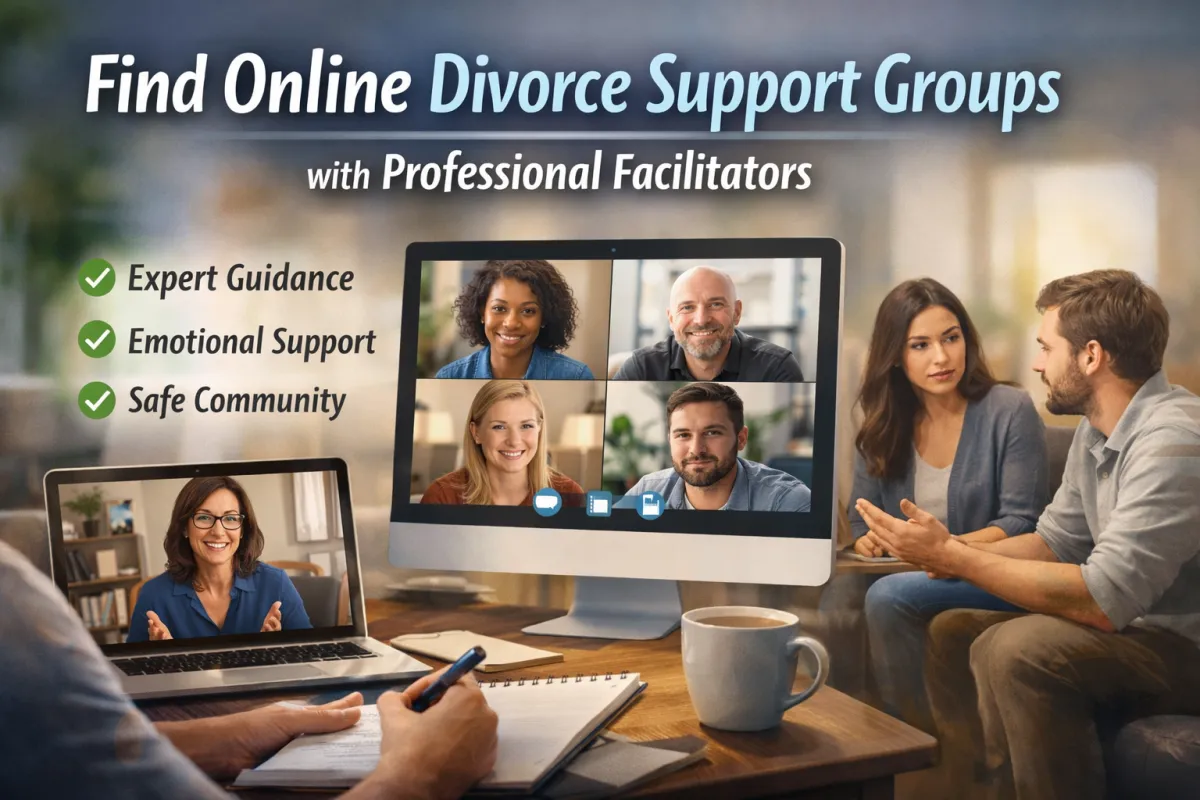
How to Find Online Divorce Support Groups with Professional Facilitators
How to Find Online Divorce Support Groups with Professional Facilitators
A practical, objective guide to choosing the right expert-led virtual support community
If you’re searching for online divorce support groups with professional facilitators you’re likely looking for more than a Facebook group.
You want structure.
You want safety.
You want someone qualified guiding the conversation.
And you want to know you’re not stepping into a chaotic space that leaves you feeling worse.
This guide walks you through how to evaluate reputable online divorce support groups with professional facilitators — and includes an objective comparison of some of the best-known options available.
Why Professional Facilitation Matters in Divorce Support
Divorce is not just a legal event — it’s emotional disorientation.
Common experiences include:
Grief and identity loss
Anger and resentment
Anxiety about finances and parenting
Shame or self-doubt
Fear of being alone
In unmoderated online spaces, those emotions can spiral. Conversations can become:
Repetitive venting
Ex-bashing
Legal advice swapping
Or worse, subtle shaming
A professionally facilitated online divorce support group provides:
Clear boundaries
Emotional containment
Topic guidance
Conflict management
Confidentiality standards
A forward-moving focus
Professional facilitation does not automatically mean therapy — but it does mean leadership is intentional and trained.
The 7 Criteria for Evaluating Online Divorce Support Groups
If you want a structured, reputable online divorce support group, use this checklist.
1. Clear, Identifiable Leadership
Ask:
Who is leading this group?
What is their training or experience?
Do they specialize in divorce recovery?
Is their philosophy clearly explained?
Reputable programs are transparent about leadership.
Red flag: No facilitator information or unclear credentials.
2. Structured Session Format
High-quality online divorce support groups typically include:
A defined weekly topic
Guided discussion
Clear time boundaries
Balanced participation
Possibly breakout rooms for smaller conversations
Structure creates psychological safety.
Unstructured venting sessions can reinforce victim mentality rather than growth.
3. Defined Community Guidelines
Look for:
Confidentiality expectations
Respectful communication rules
Limits on legal advice
No romantic solicitation policies
Clear boundaries around cross-talk
A professional facilitator actively maintains these standards.
4. Emotional Growth Focus (Not Just Problem Rehashing)
Some groups become stuck in:
Replaying betrayal stories
Comparing settlements
Rehearsing resentment
Stronger programs guide members through:
Grief processing
Anger regulation
Identity rebuilding
Boundary development
Trust restoration
The difference is subtle but important:
Are members encouraged to move forward?
5. Evidence of Impact
Look for:
Testimonials
Video feedback
Reviews
Years of operation
Consistent transformation stories are a good sign.
6. Accessibility and Consistency
Ask:
Is the group ongoing or cohort-based?
Does it meet weekly?
Is it easy to join virtually?
Is pricing transparent?
Consistency often matters more than intensity.
7. Clear Scope of Support
A reputable online divorce support group should clearly state:
It is not therapy (unless it is)
It does not provide legal advice
It focuses on emotional support and growth
Clarity builds trust.
Objective Comparison: Popular Online Divorce Support Options
Below is a balanced overview of well-known options people commonly consider when searching for expert-led online divorce support.
1. DivorceCare
Best for: Faith-based, church-centered support.
Overview:
DivorceCare is a widely available 13-week Christian divorce recovery program typically run through churches. Sessions often include video teaching and group discussion.
Strengths:
Structured curriculum
Affordable and widely accessible
Strong Christian foundation
Considerations:
Facilitators are often volunteers with little to no training rather than divorce-recovery specialists
Strongly faith-oriented (ideal for some, not for others)
Usually time-limited rather than ongoing
Best if your primary priority is Christian community and biblical encouragement.
2. Rebuilders Workshop (Fisher-based programs)
Best for: Structured multi-week curriculum with emotional recovery focus.
Overview:
Rebuilders Workshops are often 10-week structured programs centered on emotional healing after relationship loss.
Strengths:
Clear curriculum
Defined progression
Community-based learning environment
Considerations:
Availability varies by region
Often cohort-based (you may wait for start dates)
Facilitation style varies by location
Best if you prefer a defined start and end with a structured educational framework.
3. Therapist-Led Divorce Process Groups
Best for: Clinical-level support.
Overview:
These are typically hosted by licensed therapists and involve formal intake processes.
Strengths:
Clinically trained leadership
Appropriate for trauma, anxiety, or depression within therapeutic scope
Considerations:
Higher cost
More formal setting
Less community-style interaction
Best if you need clinical mental health care alongside divorce recovery.
4. Rebuilders Support Group
Best for: Ongoing, professionally facilitated emotional recovery in a structured community.
Overview:
Rebuilders offers professionally facilitated online divorce support groups designed specifically around emotional recovery and rebuilding after divorce.
How it aligns with the evaluation criteria:
Criteria:
Rebuilders Support Circle
Professional facilitation: ✔ Experienced divorce recovery facilitators
Structured sessions: ✔ Topic-based, guided discussion
Clear boundaries: ✔ Community standards enforced
Emotional growth focus: ✔ Emphasis on rebuilding identity and trust
Ongoing access: ✔ Weekly online meetings
Evidence of impact: ✔ Long track record and participant testimonials
Strengths:
Clear leadership model
Strong emotional growth orientation
Balance between structure and sharing
Ongoing weekly access
Designed specifically for divorce recovery (not generalized group therapy)
Considerations:
Not faith-based
Not therapy (though emotionally structured)
Best if you want consistent, professionally guided emotional recovery in a growth-focused environment.
Quick “Best Fit” Guide
Choose DivorceCare if:
You want Christian-based group support with a fixed curriculum.
Choose Rebuilders Workshop if:
You want a defined multi-week emotional recovery course.
Choose a therapist-led group if:
You need clinical support or mental health treatment.
Choose Rebuilders Support Group if:
You want structured, professionally facilitated, ongoing emotional recovery in a growth-oriented virtual community.
Final Thoughts
When searching for online divorce support groups with professional facilitators, the key is not just finding a group.
It’s finding the right level of structure, guidance, and emotional direction for you.
The best groups:
Contain your emotions without suppressing them
Encourage growth without rushing you
Provide connection without chaos
Offer leadership without control
Divorce is destabilizing.
The right online support group should feel steady.
If you’re evaluating options, ask questions. Observe a session if possible. Compare structure. Notice whether the group moves people forward.
The right professional support doesn’t just help you survive divorce.
It helps you rebuild.