
Divorce Is Hard: Why It Hurts So Much and What You Can Do About It

Introduction
If you typed “divorce is hard” into Google, chances are you’re in pain.
Maybe you’re curled up on the couch, staring at a quiet home that doesn’t feel like home anymore. Maybe you’re functioning on the outside—but crumbling inside. Or maybe you just need someone, anyone, to tell you that what you’re feeling is normal.
Let’s start here: Divorce is hard because it hurts. And that hurt is valid.
This isn’t a “10 tips to move on” kind of article. This is a space to exhale. To understand why divorce feels like such a wrecking ball—and how, slowly, gently, you can begin finding solid ground again.
We’ll talk about:
Why this pain is so heavy
The emotional challenges you might be facing
How to cope when it feels unbearable
What healing could look like—even if you're not there yet
You're not alone. You're not broken. You're grieving.
Why Divorce Feels So Hard
You’re Losing More Than a Partner
You’re not just ending a relationship. You’re losing:
A shared identity
A sense of emotional safety
Daily routines—morning coffee, texts, weekend rituals
A future you thought was certain
“Divorce is the death of a future you planned.”
This is why it hits so deeply. It’s not just the person—it’s the life you built around them.
It Feels Like a Personal Failure (Even If It’s Not)
Society teaches us that lasting relationships = success. So when a marriage ends, it can feel like you failed—even if you did everything you could.
The truth?
Sometimes love changes. Sometimes people grow apart. And that doesn’t make you a failure.
You’re Grieving Someone Who’s Still Alive
One of the strangest parts of divorce grief is that your ex might still be around:
Co-parenting
Showing up on social media
Moving on while you're still shattered
It’s like mourning someone who’s alive—and still visible. The emotional dissonance can be unbearable.
Stat: Nearly 20% of divorced people experience major depressive symptoms post-divorce
(Source: American Psychological Association)
Common Emotional Challenges That Make Divorce So Difficult
Emotional Whiplash
You may feel:
Sad in the morning
Angry by noon
Guilty by 3 PM
Hopeful at dinner
Numb by bedtime
This emotional rollercoaster is exhausting—but it’s also normal.
Grief doesn’t follow a schedule. It surges. It stalls. It loops.
Social Isolation and Stigma
Divorce often comes with silence. Friends don’t know what to say. People choose sides. Or worse, they disappear altogether.
You might feel like:
You're the only one going through this
You're being judged
You can’t talk about it without making people uncomfortable
Please know: there is nothing shameful about hurting.
Fear of the Unknown
“What now?”
“Will I ever love again?”
“How do I survive financially?”
“Who am I without them?”
These fears are valid. And while they can feel paralyzing, naming them helps reduce their power.
Try this: Write down your top 3 fears. Say them out loud. You don’t need to solve them today—just acknowledge them.
How to Cope When Divorce Feels Unbearable
Let Go of the “Shoulds”
“I should be over this by now.”
“I should be stronger.”
“I should have seen it coming.”
These internal narratives are cruel, and they aren’t helping you heal.
Try replacing them with:
“I’m doing my best.”
“I’m allowed to hurt.”
“This pain is part of my process.”
Create Safe Spaces to Fall Apart
You don’t need to hold it together all the time.
Find private spaces where you can:
Scream
Cry
Write unsent letters
Talk to yourself in the mirror
Record voice notes when the pain swells
You don’t need to explain your grief to anyone but yourself.
Focus on Micro-Wins
Some days, surviving is enough.
You got out of bed.
You fed yourself.
You answered one text.
That’s not failure—that’s resilience in motion.
E-A-T Tip: Trauma-informed therapists can help you process grief in safe, supported ways. Consider online platforms like Rebuilders International.
What Healing Might Look Like (Even If It’s Not Here Yet)
The Pain Doesn’t Disappear — It Transforms
One day the pain will feel:
Less sharp
Less all-consuming
More like a scar than an open wound
You’ll still remember. But it won’t break you anymore.
You’ll Start to Feel Okay Without Realizing It
Healing sneaks in like this:
You laugh, and it doesn’t feel like betrayal
You go hours—then a day—without thinking of them
You notice a sunrise, a song, a small joy
And slowly, life starts to expand again.
“Healing doesn’t mean the damage never existed. It means it no longer controls your life.” — Unknown
Final Words: You’re Not Weak — You’re Human
It’s hard because you cared.
It’s hard because it mattered.
It’s hard because you loved.
You don’t have to have it all figured out.
You just need to know this:
You will not feel this way forever.
You are not broken—you are becoming.
Further Reading: Reclaiming Your Identity and Overcoming Shame
When your entire identity was wrapped up in being a provider, spouse, and full-time parent, an unwanted divorce can make you feel like a complete failure. Use these resources to rebuild your self-worth and overcome the secret shame of falling apart:
-
Overcoming Divorce Shame
Unpacking the heavy burden of feeling like you failed at the most important thing, and how to release the stigma of asking for help. -
Rediscovering Your Identity Post-Divorce
How to figure out who you are now that the titles of "spouse" and "full-time parent" have drastically changed. -
Mastering Your Emotions: Confronting Regret, Guilt, and Shame
Actionable strategies for processing the guilt of the past without letting it destroy your future or your competence. -
7 Ways to Improve Your Self-Image During Divorce
Reclaiming your confidence when you feel broken, exhausted, and unrecognizable in the mirror. -
Dealing with Loneliness After Divorce: Ways to Reconnect and Find Joy
How high-achievers can overcome the instinct to isolate and actively rebuild a supportive inner circle. -
The Drama Triangle: Finding Your Way Out of Victim Consciousness
Recognizing toxic relationship dynamics and taking back your power when you feel like you have lost total control.
Related Posts
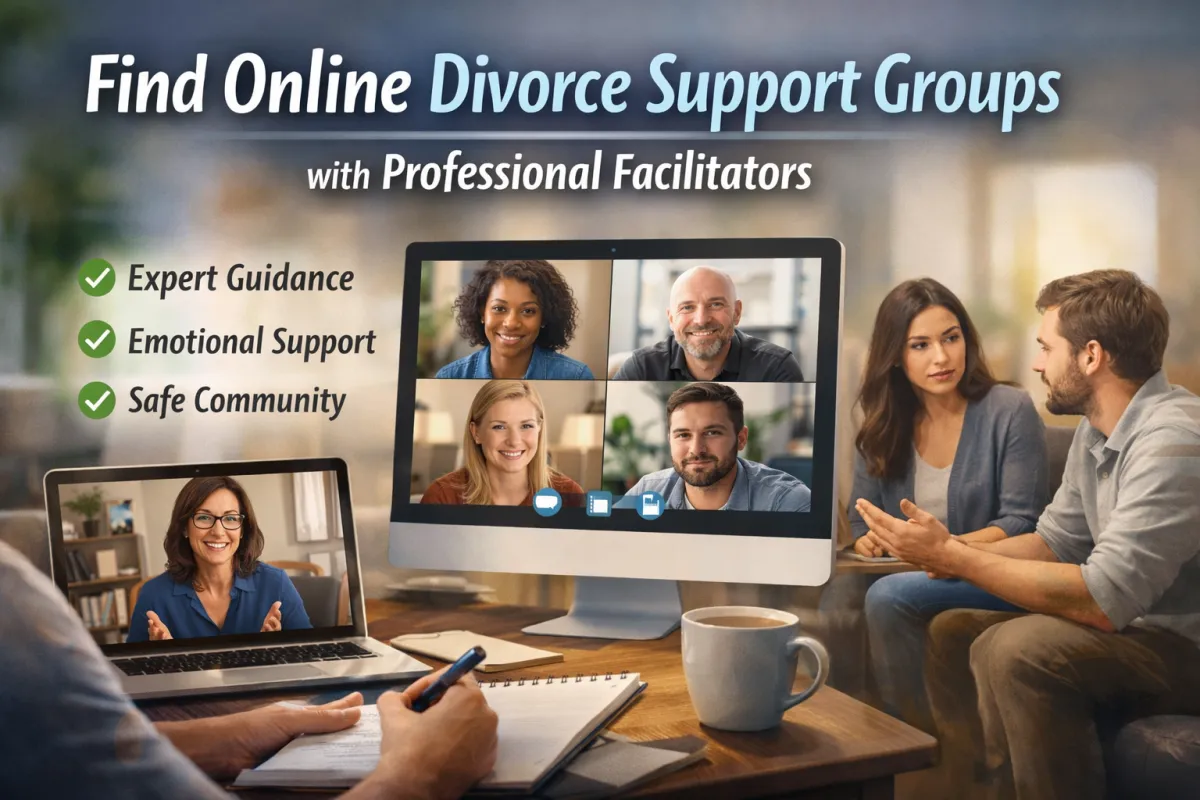
How to Find Online Divorce Support Groups with Professional Facilitators
How to Find Online Divorce Support Groups with Professional Facilitators
A practical, objective guide to choosing the right expert-led virtual support community
If you’re searching for online divorce support groups with professional facilitators you’re likely looking for more than a Facebook group.
You want structure.
You want safety.
You want someone qualified guiding the conversation.
And you want to know you’re not stepping into a chaotic space that leaves you feeling worse.
This guide walks you through how to evaluate reputable online divorce support groups with professional facilitators — and includes an objective comparison of some of the best-known options available.
Why Professional Facilitation Matters in Divorce Support
Divorce is not just a legal event — it’s emotional disorientation.
Common experiences include:
Grief and identity loss
Anger and resentment
Anxiety about finances and parenting
Shame or self-doubt
Fear of being alone
In unmoderated online spaces, those emotions can spiral. Conversations can become:
Repetitive venting
Ex-bashing
Legal advice swapping
Or worse, subtle shaming
A professionally facilitated online divorce support group provides:
Clear boundaries
Emotional containment
Topic guidance
Conflict management
Confidentiality standards
A forward-moving focus
Professional facilitation does not automatically mean therapy — but it does mean leadership is intentional and trained.
The 7 Criteria for Evaluating Online Divorce Support Groups
If you want a structured, reputable online divorce support group, use this checklist.
1. Clear, Identifiable Leadership
Ask:
Who is leading this group?
What is their training or experience?
Do they specialize in divorce recovery?
Is their philosophy clearly explained?
Reputable programs are transparent about leadership.
Red flag: No facilitator information or unclear credentials.
2. Structured Session Format
High-quality online divorce support groups typically include:
A defined weekly topic
Guided discussion
Clear time boundaries
Balanced participation
Possibly breakout rooms for smaller conversations
Structure creates psychological safety.
Unstructured venting sessions can reinforce victim mentality rather than growth.
3. Defined Community Guidelines
Look for:
Confidentiality expectations
Respectful communication rules
Limits on legal advice
No romantic solicitation policies
Clear boundaries around cross-talk
A professional facilitator actively maintains these standards.
4. Emotional Growth Focus (Not Just Problem Rehashing)
Some groups become stuck in:
Replaying betrayal stories
Comparing settlements
Rehearsing resentment
Stronger programs guide members through:
Grief processing
Anger regulation
Identity rebuilding
Boundary development
Trust restoration
The difference is subtle but important:
Are members encouraged to move forward?
5. Evidence of Impact
Look for:
Testimonials
Video feedback
Reviews
Years of operation
Consistent transformation stories are a good sign.
6. Accessibility and Consistency
Ask:
Is the group ongoing or cohort-based?
Does it meet weekly?
Is it easy to join virtually?
Is pricing transparent?
Consistency often matters more than intensity.
7. Clear Scope of Support
A reputable online divorce support group should clearly state:
It is not therapy (unless it is)
It does not provide legal advice
It focuses on emotional support and growth
Clarity builds trust.
Objective Comparison: Popular Online Divorce Support Options
Below is a balanced overview of well-known options people commonly consider when searching for expert-led online divorce support.
1. DivorceCare
Best for: Faith-based, church-centered support.
Overview:
DivorceCare is a widely available 13-week Christian divorce recovery program typically run through churches. Sessions often include video teaching and group discussion.
Strengths:
Structured curriculum
Affordable and widely accessible
Strong Christian foundation
Considerations:
Facilitators are often volunteers with little to no training rather than divorce-recovery specialists
Strongly faith-oriented (ideal for some, not for others)
Usually time-limited rather than ongoing
Best if your primary priority is Christian community and biblical encouragement.
2. Rebuilders Workshop (Fisher-based programs)
Best for: Structured multi-week curriculum with emotional recovery focus.
Overview:
Rebuilders Workshops are often 10-week structured programs centered on emotional healing after relationship loss.
Strengths:
Clear curriculum
Defined progression
Community-based learning environment
Considerations:
Availability varies by region
Often cohort-based (you may wait for start dates)
Facilitation style varies by location
Best if you prefer a defined start and end with a structured educational framework.
3. Therapist-Led Divorce Process Groups
Best for: Clinical-level support.
Overview:
These are typically hosted by licensed therapists and involve formal intake processes.
Strengths:
Clinically trained leadership
Appropriate for trauma, anxiety, or depression within therapeutic scope
Considerations:
Higher cost
More formal setting
Less community-style interaction
Best if you need clinical mental health care alongside divorce recovery.
4. Rebuilders Support Group
Best for: Ongoing, professionally facilitated emotional recovery in a structured community.
Overview:
Rebuilders offers professionally facilitated online divorce support groups designed specifically around emotional recovery and rebuilding after divorce.
How it aligns with the evaluation criteria:
Criteria:
Rebuilders Support Circle
Professional facilitation: ✔ Experienced divorce recovery facilitators
Structured sessions: ✔ Topic-based, guided discussion
Clear boundaries: ✔ Community standards enforced
Emotional growth focus: ✔ Emphasis on rebuilding identity and trust
Ongoing access: ✔ Weekly online meetings
Evidence of impact: ✔ Long track record and participant testimonials
Strengths:
Clear leadership model
Strong emotional growth orientation
Balance between structure and sharing
Ongoing weekly access
Designed specifically for divorce recovery (not generalized group therapy)
Considerations:
Not faith-based
Not therapy (though emotionally structured)
Best if you want consistent, professionally guided emotional recovery in a growth-focused environment.
Quick “Best Fit” Guide
Choose DivorceCare if:
You want Christian-based group support with a fixed curriculum.
Choose Rebuilders Workshop if:
You want a defined multi-week emotional recovery course.
Choose a therapist-led group if:
You need clinical support or mental health treatment.
Choose Rebuilders Support Group if:
You want structured, professionally facilitated, ongoing emotional recovery in a growth-oriented virtual community.
Final Thoughts
When searching for online divorce support groups with professional facilitators, the key is not just finding a group.
It’s finding the right level of structure, guidance, and emotional direction for you.
The best groups:
Contain your emotions without suppressing them
Encourage growth without rushing you
Provide connection without chaos
Offer leadership without control
Divorce is destabilizing.
The right online support group should feel steady.
If you’re evaluating options, ask questions. Observe a session if possible. Compare structure. Notice whether the group moves people forward.
The right professional support doesn’t just help you survive divorce.
It helps you rebuild.